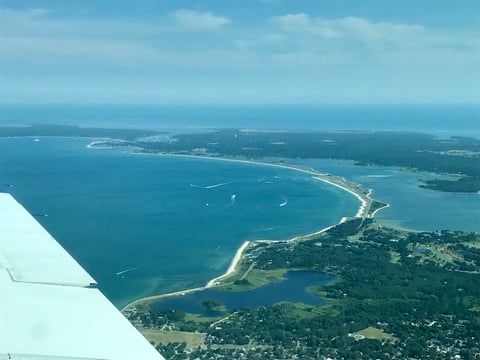
The approach into Martha's Vineyard Airport is unlike any other. The plane drops below the clouds and suddenly there is nothing but open water, salt marsh, and the particular stillness of a place that has decided, long ago, not to announce itself.
There is no skyline to orient yourself by, no grid of highways fanning out from a center, no signs of the kind of density that announces arrival into somewhere important. There is just the island, held in the Atlantic, going quietly about its own life below you. I have made this approach more times than I can count, and it still does something to me. The shoulders drop. The breath slows. Something that had been wound tight on the mainland begins, without effort, to release.
That feeling has a name. It is not quite peace, not quite escape. It is privacy, and for those who have been coming to Martha's Vineyard for decades, it is the whole point. It is not a feature of the real estate. It is the foundation of it.
I have spent my career working in private Martha's Vineyard real estate, and the one thing I can tell you with certainty is this: the buyers who find their way here are not looking for a luxury destination. They are looking for a place that protects something. Their time. Their name. And increasingly, in a world that has made visibility a liability, they are committed to prioritizing that protection.
The Vineyard Has Always Protected Its Own
Other luxury destinations were designed to be seen. Their architecture reaches toward the road, their restaurants are famous, their beaches are photographed. They perform exclusivity while quietly depending on the attention that exclusivity attracts.
Martha's Vineyard was never interested in that arrangement.
The legacy builders who summered here in the 1920s, who built their shingled houses behind deep hedgerows and down long, unmarked driveways, did not do so because privacy was fashionable. They did so because they understood, instinctively, that a place is only as good as what it keeps out. The artists who arrived in the 1950s, the writers, the painters, the thinkers who needed silence to work, chose the Up-Island farms and the Menemsha harbors for the same reason. When the Kennedys came, they did not change the culture of discretion here. They submitted to it.
This is the inheritance of the Vineyard: a generational agreement, unwritten and unenforceable, that says we do not point, we do not stare, we do not post. A presidential motorcade can move through Edgartown on a Tuesday morning and locals will continue their conversations, their coffee, their errands without a second glance. That is not security infrastructure. That is values.
Other luxury destinations perform exclusivity. Martha's Vineyard simply is.
What Privacy Actually Looks Like Here
Privacy on Martha's Vineyard is not one thing. It wears different clothes in different towns and takes different shapes depending on what you need it to do. Understanding those distinctions is the first work of finding the right property, or the right agent to sell one.
Up-Island: The Deep Quiet of Chilmark and Aquinnah
Drive Up-Island and the roads narrow, the pavement gives way to packed dirt, and the properties pull back from the road entirely. This is not a design flaw in the infrastructure. It is the infrastructure.
Chilmark is where the island keeps its deepest privacy. Estates sit on ten, twenty, sixty acres, not as a status statement but as a buffer. The Martha's Vineyard Land Bank has permanently conserved nearly forty percent of the island's land, which means a property that abuts conservation land today will abut conservation land forever. That view, that silence, that sense of being the only house in the world is not an accident, and it cannot be manufactured once it is gone.
Here, privacy is ecological. The land itself holds you apart from everything else.
Edgartown: Privacy With a Village Address
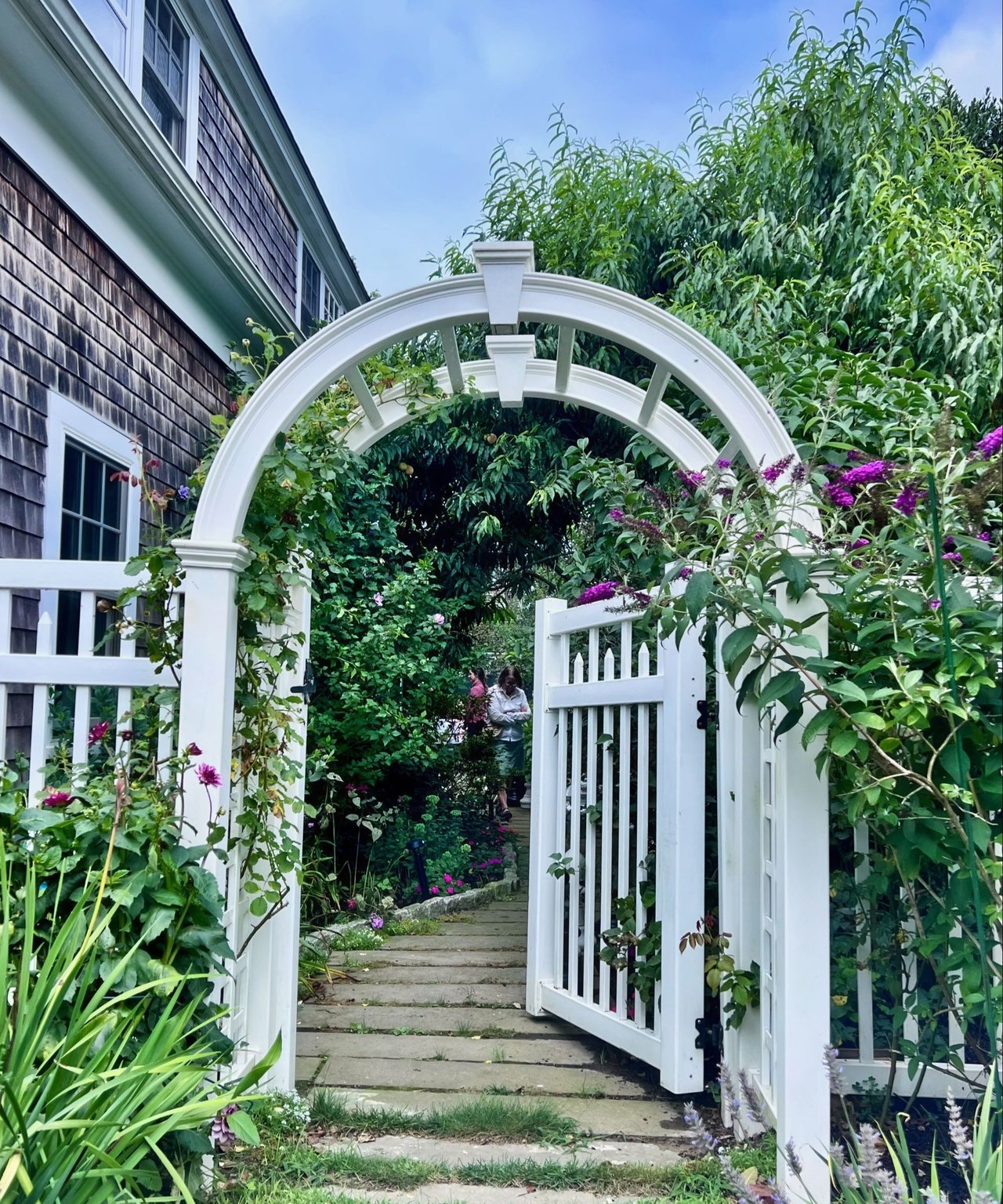
In Edgartown, privacy is architectural. The captain's houses on North Water Street were built in the eighteenth century to face inward and to reveal nothing from the road. Their gardens are walled and their gates are latched. You can walk past a twelve-room compound and see only a white fence and a climbing rose.
This is a different kind of seclusion, the privacy of the inner life, of rooms that look out onto private gardens rather than public streets. For buyers who want the convenience of the village (the harbor, the restaurants, the ferry to Chappaquiddick) without surrendering their anonymity, Edgartown's historic district offers something genuinely rare: privacy by design, in the middle of everything.
Chappaquiddick: The Island Within the Island
Chappaquiddick is the Vineyard's final answer to anyone who thinks the main island is not private enough. It is accessible only by the On Time ferry, a three-car vessel that runs on no schedule and answers to no clock. There is no through traffic because there is nowhere through to go.
The properties on Chappaquiddick are legacy estates by nature. They do not turn over often, and when one does, it is a true event: an 18-acre compound with four conforming parcels and beach access, the kind of offering that defines a market rather than simply participating in it. These are generational holdings. The island within the island is for those who have decided, finally, that enough distance from the rest of the world is not a luxury but a necessity.
Why Discerning Connoisseurs Are Choosing Seclusion Over Status
The shift is real, and it has been building for years. The legacy builders moving through the luxury market in 2025 and 2026 are not the same buyers who were building glass and steel spectacles in the Hamptons a decade ago. They are retreating, quietly and deliberately, from the overcrowded, overexposed, overmarketed destinations that require visibility as the price of entry.
Social media has changed the calculus entirely. What was once a private summer became a public performance, and what was once a quiet compound became content. For highly private individuals who value security and who understand that visibility is a form of vulnerability, the Vineyard offers something that Aspen and Nantucket, Palm Beach and Saint-Tropez increasingly cannot: a place where the culture itself protects your privacy, where no one will photograph your dinner, and where the neighbor who knows your name also knows not to say it.
What buyers who prize privacy are looking for, and where the Vineyard delivers:
- No road traffic visible from private land, with driveways designed to be approached rather than stumbled upon
- Mature tree lines and specimen plantings that took decades to grow and cannot be replicated by a developer
- Acreage that buffers without fencing and creates distance through landscape rather than barrier
- Water access that is yours alone, including private beach, private dock, and private pond frontage with no shared shoreline to negotiate
- Conservation adjacency that makes the privacy permanent, so that the view is protected not by contract but by deed
- A community that has collectively decided not to perform itself for outsiders
The Private Market: How the Most Discreet Properties Move
The most significant estates on this island rarely appear on Zillow. They move through relationships, through conversations that begin at the yacht club or over coffee in Edgartown, that develop over months, and that conclude without a public auction or a bidding war or a listing that anyone outside the transaction ever sees.
Many luxury property transactions now happen off market, driven by sellers who value discretion above the marginal premium of public exposure, and on Martha's Vineyard that number is higher. The sellers who reach out to me are not optimizing for the highest bid. They are optimizing for certainty, for speed, and for the protection of their name.
Buyers at this level do not browse. They call someone they trust, someone who knows which highly private individuals are quietly considering a transition, who understands the difference between a property that claims privacy and one that actually delivers it, and who can navigate a conversation before it becomes a listing.
What to Look for in a Private Estate on Martha's Vineyard
Not every property that claims privacy delivers it. The word appears in nearly every listing on the island, applied to half-acre lots with neighbors thirty feet away and to sixty-acre oceanfront compounds with equal enthusiasm. Here is what actually matters.
- Acreage with intent. Look for land that buffers rather than land that simply exists, with mature growth, natural screening, and conservation adjacency that makes the buffer permanent.
- The approach. A long, private driveway is not an inconvenience. It is a statement that this property was designed to be arrived at rather than discovered, and it is the first form of privacy you encounter.
- Water privacy. Who shares the shoreline? Private pond frontage and deeded beach rights are not the same thing, and it is worth asking precisely.
- Compound potential. Guest houses, accessory structures, and multi-parcel configurations allow a legacy estate to grow across generations, and the best holdings have room for everyone to have their own space within them.
- Title history. Long held estates carry something that new construction cannot replicate. A property that stayed in one stewardship for sixty years tells you something meaningful about what it offers.
- Conservation adjacency. A property that abuts Land Bank or Sheriff's Meadow land is permanently buffered, and that view and that silence will not change. This is the only guarantee the island can make, and it is a significant one.
A Note on What You Cannot Buy
The acreage, the long driveway, the conservation easement, the deeded beach rights: these are things that appear in a listing and can be negotiated, conveyed, and recorded at the county registry.
What cannot be purchased is the culture.
The social contract among longtime island residents, the understanding that we do not comment, do not photograph, and do not perform our summer for an audience, is not written anywhere. It is transmitted between people who have been coming here long enough to understand what the island asks of them. It is why someone can spend August here, truly, without a single intrusion, without a photograph taken without consent, and without the feeling of being observed that is constant and exhausting in other places.
The connoisseurs of heritage who have been coming to Martha's Vineyard for sixty summers are not protecting a vacation. They are protecting a way of being in the world that is increasingly rare and increasingly unavailable at any price in most other places. What they are protecting, finally, is the right to simply live.
That is a finite thing. The land bank can only conserve so much land, and the dirt roads can only carry so many people before something is lost. The culture of discretion holds as long as the people who hold it remain in the majority, which is one reason why those who understand this are not waiting.
Frequently Asked Questions
What makes Martha's Vineyard more private than the Hamptons or Nantucket?
Martha's Vineyard's privacy is structural, cultural, and geographic rather than manufactured. The island's land conservation efforts have permanently protected nearly forty percent of its land from development, creating buffers that cannot be undone. Its social culture, established over generations by the artists, academics, and culturally fluent stewards who chose it specifically for its quietude, actively discourages the performance and observation economy that defines the Hamptons and Saint-Tropez. There is no paparazzi culture, no nightlife economy, and no velvet rope. The privacy here is not a product. It is a value that the community holds collectively.
What are the most private towns on Martha's Vineyard?
Chilmark and Aquinnah offer the deepest Up-Island seclusion, with large acreage, dirt roads, and conservation adjacency that makes the privacy permanent. Chappaquiddick, accessible only by ferry, is the island's most truly isolated enclave, and its estates rarely come to market. Edgartown's historic district offers a different kind of privacy, one that is architectural and inward turning, with walled compounds steps from the village. West Tisbury provides a pastoral middle ground of working farmland, conservation fields, and a quietude that feels genuinely unhurried.
How do off market real estate transactions work on Martha's Vineyard?
Private transactions on Martha's Vineyard move through relationships rather than public listings. A seller who values discretion reaches out to a trusted agent who maintains a private network of qualified buyers, and the agent makes introductions based on fit, budget, timeline, and intended use without exposing the property or the seller's identity to the open market. These transactions protect both parties: sellers avoid public scrutiny and the instability of open bidding, while buyers gain access to properties that never reach Zillow or the MLS. Access to this world requires a direct relationship with an agent who operates within it.
What should I look for in a private estate on Martha's Vineyard?
True privacy on the Vineyard comes from a combination of factors: meaningful acreage with mature natural screening rather than just a posted boundary line, a substantial private approach, exclusive water access with no shared shoreline, compound potential for generational use, and most importantly, conservation adjacency that makes the buffer permanent. A property that abuts Land Bank or Sheriff's Meadow land cannot be developed by a future neighbor, and that permanence is the rarest and most valuable feature a Vineyard estate can offer.
How do I sell my Martha's Vineyard home without a public listing?
Selling a Vineyard estate off market begins with a private conversation with an agent who maintains a vetted network of discerning buyers at the highest tier of the market. The property is presented selectively to buyers whose profile, budget, and timeline are a genuine match, rather than broadcast publicly. This approach protects the seller's privacy, avoids the disruption of open houses and public showings, and often results in a cleaner, faster transaction. Sellers who prioritize discretion over the optics of a competitive bidding process consistently choose this path.